The problem
Characterizing a power amplifier means coordinating three instruments, sequencing bias in an order that won’t destroy the part, and correcting for cable losses. Every step is easy to get silently wrong.
What it does
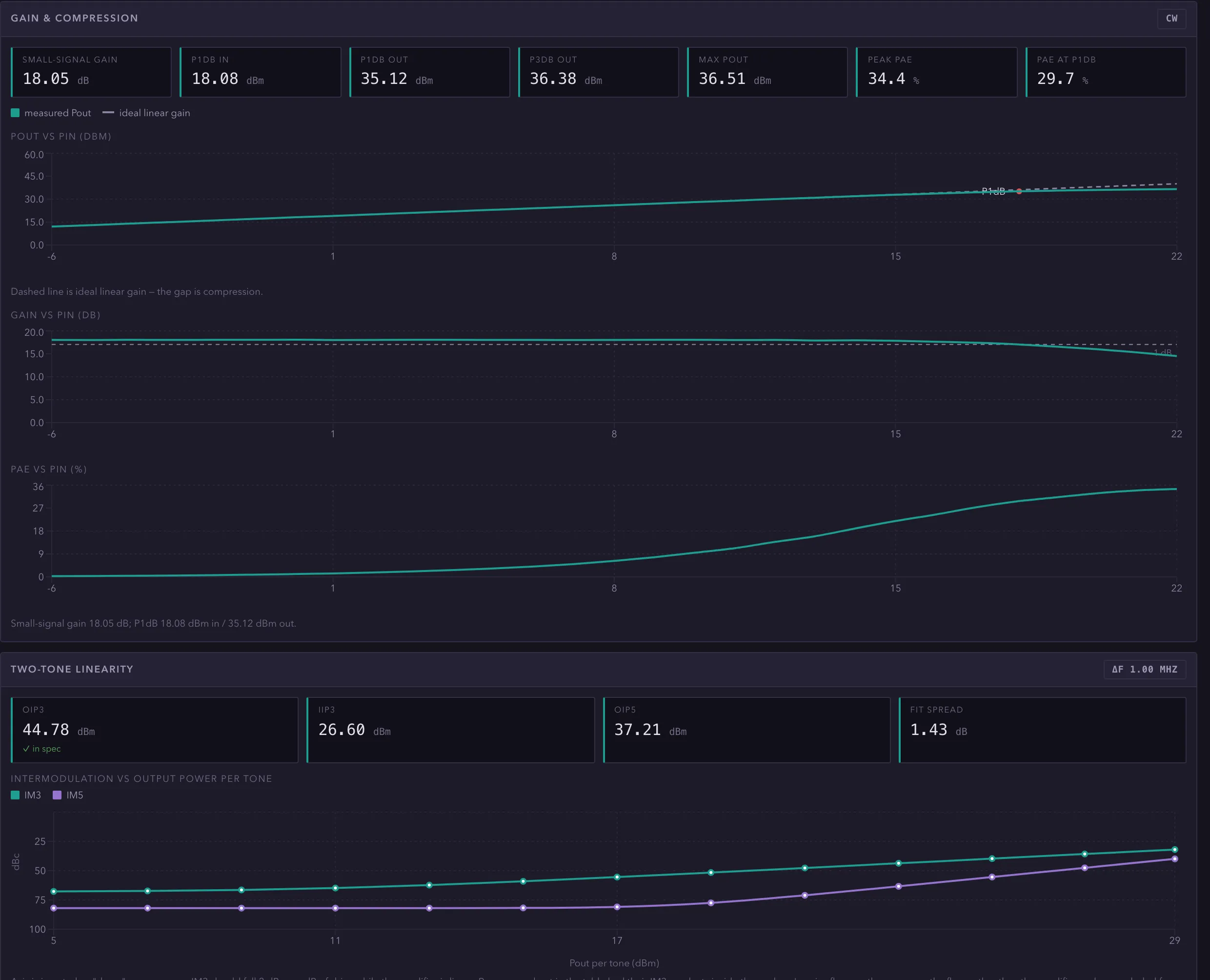
- Gain and compression: gain, P1dB, P3dB, Psat, PAE and drain current at every step.
- Two-tone linearity: IM3, IM5, OIP3 and IIP3, fitted only over the range where the slope is valid.
- Multicarrier: up to 12 carriers with per-carrier EVM, guard-band ACPR and flatness.
- Safe bias sequencing: gate to pinch-off before the drain comes up, with automatic unwinding on any fault.
- Traceable reports: every report records the DUT, bias, stimulus, calibration state and each instrument’s identity.
Why it’s trustworthy
The math is checked by 107 tests derived from first principles, a simulated bench exercises the same code paths as the real instruments, and a SCPI-log replay confirms every measurement was taken where the generator was actually transmitting. The images show the simulated bench.